Interdental brushes and picks — how to do it right
Step by step, with the technique that makes the difference.
On this page:
- → Video: the technique in practice
- → The golden rule: always support your hand
- → Step by step
- → Common questions (bleeding, bending, cannot reach, cannot get through)
- → How to make it a habit
Watch the video first
This short video shows how to use an interdental brush or pick. Pay attention to how the hand is supported — that is exactly what we explain in more detail below.
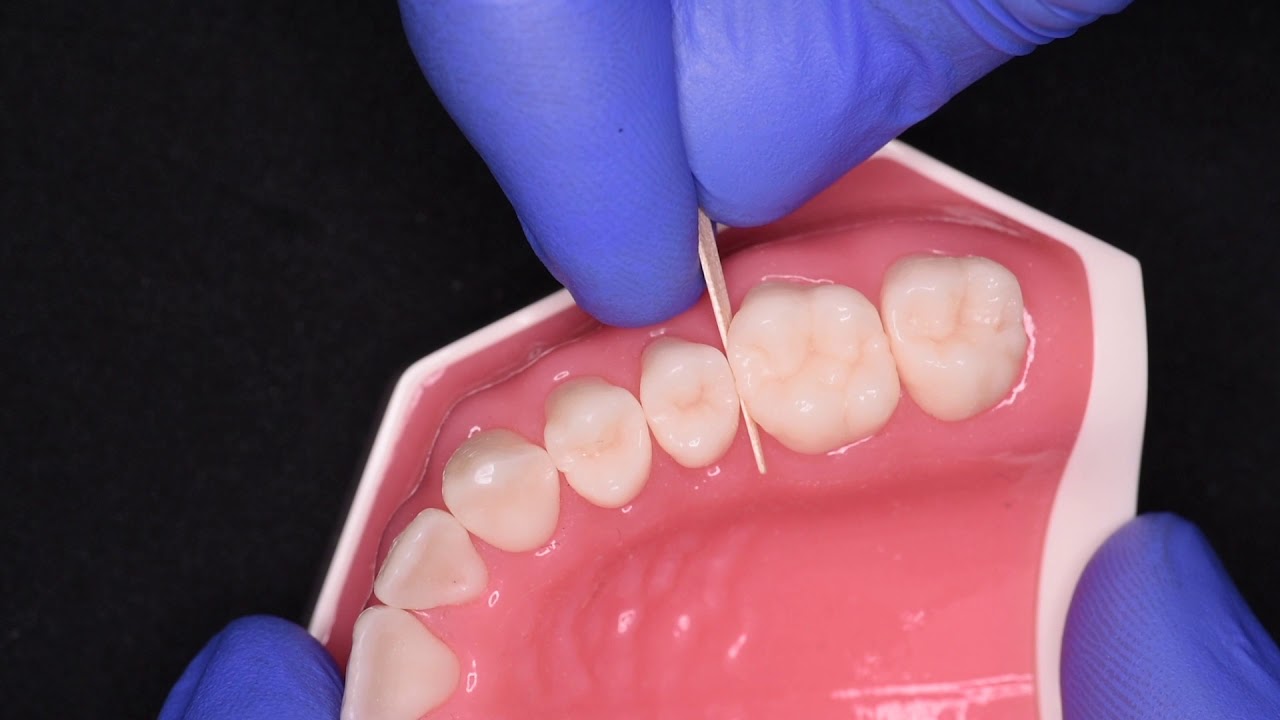
Instructional video on YouTube
Why brushing alone is not enough
The spaces between your teeth are where tooth decay and gum disease most often begin. A toothbrush — even an electric one — barely reaches there. Interdental brushes and picks fill that gap.
Nearly half left uncleaned. About 40% of the tooth surface lies between the teeth. Without interdental cleaning, you leave nearly half of your mouth untouched.
The golden rule: always support your hand
The real secret is not the brush itself, but how you hold it. Good support gives you far more control and prevents the brush from bending or pressing too hard.
How to do it: Hold the brush or pick between your thumb and index finger. Rest your middle finger (or ring finger) against your chin or cheek. This support gives you control over the movement and prevents accidentally pressing too hard.
Step by step
- Hold the brush or pick in your dominant hand.
- Support your hand against your face (chin, cheek or lip).
- Gently enter the space — do not force it.
- Move the brush back and forth a few times.
- Move to the next space. Rinse the brush when it is dirty.
Use a mirror when you start — you will learn the movement much faster when you can see what you are doing.
Common questions
"It bleeds."
That is normal when the gums are inflamed. The bleeding is a sign that inflammation was already there. After a week of gentle daily cleaning it will be much less.
"The brush bends."
You are pressing too hard, or the size is too thin. Try a slightly thicker size or work even more gently.
"I cannot reach everywhere."
That is completely normal. Start with the easy spots. The difficult ones will come naturally as your fingers learn the movement.
"I cannot get through in the lower front at all."
This probably means the teeth there are very close together, that tartar is blocking the way, or both. Do not try to force it — you can damage your gums. Contact your dentist or dental hygienist. They can remove the tartar and show you which method works best for your teeth.
How to make it a habit
- Do it at the same time every day — e.g. right after your evening brushing.
- Keep the brushes next to your toothbrush or on your bedside table.
- Start with the easy spots — the rest will follow.
- Perfection is not required. Doing something is always better than doing nothing.
Result after two weeks: Most people notice less bleeding, calmer gums and a fresher feeling in the mouth. Gums recover quickly when given the chance.
Scientific sources
- Sunstar GUM (2025). If you don't clean between your teeth, you miss up to 40% of tooth surfaces.
- Slot DE, et al. (2008). The efficacy of interdental brushes on plaque and periodontal inflammation. Int J Dental Hygiene, 6(4):253-264.
- Worthington HV, et al. (2019). Home use of interdental cleaning devices. Cochrane Database Syst Rev, (4):CD012018.
- Smith PC, et al. (2015). Gingival wound healing. Periodontology 2000, 68(1):83-103.
mijngebit.info is not a medical device. If in doubt, consult your dentist.